
T20 World Cup 2026 Qualification Explained: How Teams Earned Their Place
Every T20 World Cup cycle brings confusion around qualification. With automatic entries, ICC rankings, and regional qualifiers all playing a role, it’s not always easy for fans to understand how teams make it to the main event.
The T20 World Cup 2026 qualification process follows a structured system that balances performance, rankings, and regional representation. This blog explains how teams qualified for the T20 World Cup 2026, step by step, while also naming the teams that progressed through each route.
How Many Teams Will Play in the T20 World Cup 2026?
The T20 World Cup 2026 will feature 20 teams, continuing the expanded format used in recent editions. Unlike earlier tournaments where most teams qualified directly, qualification for 2026 was split across multiple paths to ensure both competitiveness and global inclusion.
Teams qualified through host nation entry, performance in the previous T20 World Cup, ICC T20I rankings, and regional qualification tournaments.
Automatic Qualification for T20 World Cup 2026
Automatic qualification played a key role in determining the final list of teams.
Host Nation Qualification
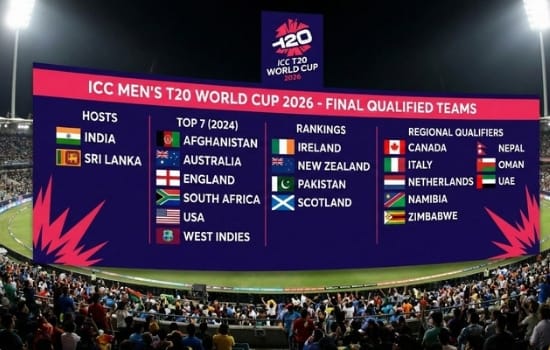
The T20 World Cup 2026 will be jointly hosted by India and Sri Lanka. As hosts, both teams qualified automatically and did not need to participate in qualifiers.
Teams qualified as hosts are India and Sri Lanka.
Top Teams from the Previous T20 World Cup
Teams that reached the Super 8 stage of the T20 World Cup 2024 earned direct qualification for the 2026 edition. This performance-based rule rewards teams that delivered strong results at the previous World Cup.
Teams qualified via 2024 performance are Australia, England, Pakistan, New Zealand, South Africa, West Indies, Afghanistan, and the United States of America
The USA qualification stands out as the team earned its place through on-field performance rather than regional qualifiers.
ICC T20I Rankings Qualification Explained
The ICC T20I rankings were used to determine additional automatic qualifiers based on a cut-off date set by the ICC. Full-member teams ranked above the cut-off qualified directly, while those below were required to enter regional qualification tournaments.
Teams qualified via ICC rankings are Bangladesh, Ireland, and Zimbabwe. Rankings-based qualification highlights the importance of consistent bilateral T20I performances.
Regional Qualifiers for T20 World Cup 2026
Regional qualifiers decided the remaining spots and were especially important for associate nations.
Africa Qualifiers
Africa offered limited qualification spots, leading to intense competition among associate teams. Namibia qualified from the Africa region.
Asia Qualifiers
The Asia qualifiers are among the most competitive pathways, featuring several strong associate teams. Nepal and Oman secured qualification from Asia.
Europe Qualifiers
Europe follows a structured qualification format with sub-regional and final stages. Netherlands and Italy qualified from Europe.
Americas Qualifiers
The Americas region had a limited number of spots, increasing the pressure on teams. Canada qualified from the Americas qualifiers.
East Asia–Pacific (EAP) Qualifiers
The EAP region continues to produce emerging cricket nations. United Arab Emirates qualified from the EAP pathway.
How Associate Nations Qualify for the T20 World Cup
Associate nations primarily rely on regional qualification tournaments to reach the T20 World Cup. Unlike full-member teams, they do not have the protection of rankings-based qualification, making every qualifier match crucial. These tournaments often produce breakthrough World Cup appearances that strengthen global cricket.
Qualification Timeline – When Does the Process Start?
The T20 World Cup qualification cycle begins several years before the tournament. Teams plan bilateral T20I series, regional events, and long-term squad strategies to improve rankings and prepare for qualification tournaments.
Can a Full Member Fail to Qualify for the T20 World Cup?
Yes. A full-member team can fail to qualify if it falls below the ICC ranking cut-off or underperforms in qualification tournaments. Qualification is not guaranteed and remains performance-driven.
What Happens If Teams Finish Equal in Qualifiers?
If teams finish level on points in qualifiers, Net Run Rate (NRR) is used as the primary tie-breaker. If teams remain tied, head-to-head results and ICC tournament rules are applied.
Common Myths About T20 World Cup Qualification
Many believe that all full-member teams qualify automatically, that hosts must play qualifiers, or that rankings alone decide qualification. In reality, the process involves multiple performance-based pathways.
Final Summary – T20 World Cup 2026 Qualification Explained
The T20 World Cup 2026 qualification system combines host entry, previous World Cup performance, ICC rankings, and regional qualifiers to determine the 20 participating teams. This approach rewards performance, ensures competitive balance, and promotes the global growth of cricket.
Frequently Asked Questions
How many teams qualify automatically for the T20 World Cup 2026?
Host nations and top performers from the previous T20 World Cup qualify automatically.
Do associate teams have a chance to qualify?
Yes. Associate teams qualify through regional qualification tournaments.
Does ICC ranking guarantee qualification?
No. Rankings help, but teams below the cut-off must play qualifiers.
Are qualifiers different for each region?
Yes. Each region follows its own ICC-approved structure.
When will the final qualified teams be confirmed?
Final confirmation comes after all regional qualifiers are completed.